

Female Pattern Hair Loss: Specialist Care in Birmingham
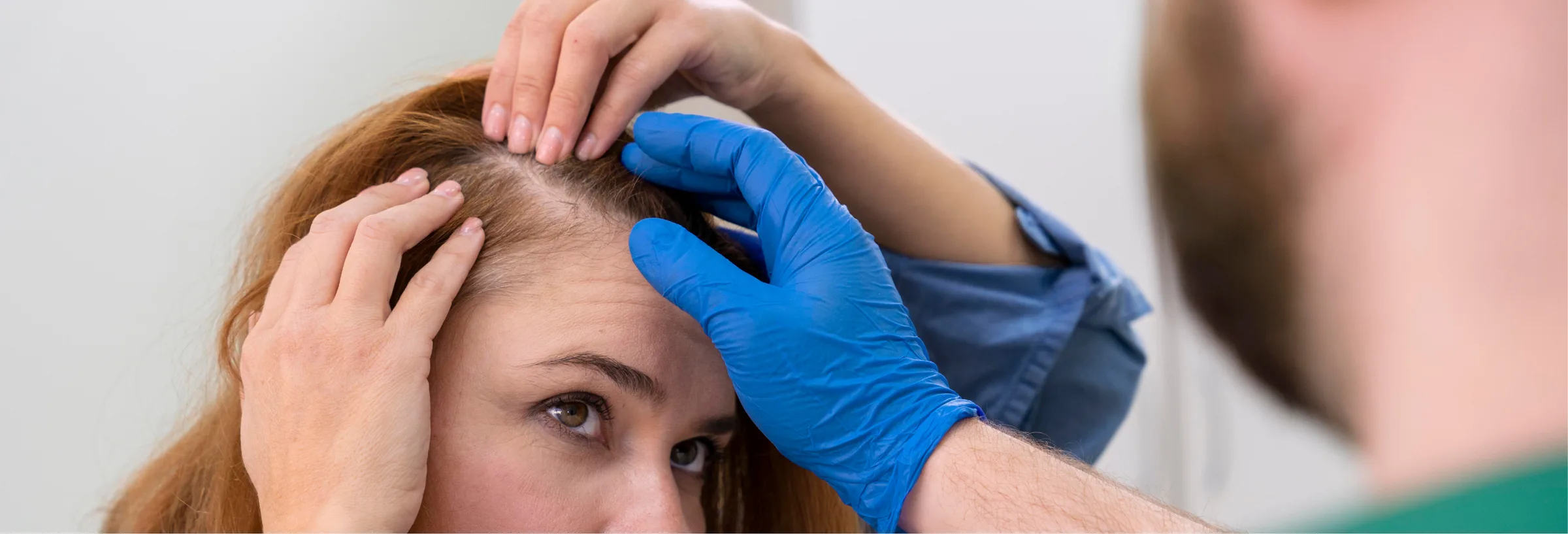
Female pattern hair loss (female androgenetic alopecia) is the most common type of hair loss in women. It shows up as a widening parting and thinner hair on top of the head.
Our doctor-led hair loss team in Birmingham reviews your hormones, iron, thyroid and menopause stage to find the cause and protect the hair you have.
What is Female Pattern Hair Loss?
Female pattern hair loss is a slow thinning of the hair on top of your head. It happens when hair roots become sensitive to hormones and shrink over time. Each new hair grows back finer and shorter, so your hair loses volume. Unlike men, most women keep their front hairline, and complete baldness is rare.
Instead, the parting widens, and the scalp shows through more easily. It can start at any age after puberty, but it often becomes more noticeable around menopause, when hormone levels change. Low iron or thyroid problems can make it worse.
At House of Health, we look at your hair and your whole health together, because thinning hair is often a sign of what is happening inside your body.
As Seen On







Stages on the Ludwig Scale
This type of hair loss tends to progress slowly over years. Doctors often grade it with the Ludwig scale. Our team uses a close scalp exam and AI scalp maps to see exactly what stage you are at:
Early Changes
Your hair feels less full, and your ponytail may feel a little smaller. New hairs grow back finer.
Widening Parting (Ludwig Grade I)
Your central parting looks wider than it used to, especially under bright light.
Visible Thinning on Top (Ludwig Grade II)
The top of your head looks clearly thinner, and more scalp shows through.
Advanced Thinning (Ludwig Grade III)
Hair on the top of the scalp is very sparse, though the front hairline usually stays in place.
Signs: Widening Parting and Thinning on Top
Thinning creeps up over time, so many women notice it late. However, as more hair roots shrink, common signs include:
- A widening parting or a 'Christmas tree' pattern of thinning along the parting
- Hair thinning on top of the head, with the front hairline still in place
- A thinner ponytail and hair that feels finer or flatter
- More scalp showing under bright light, with no bald patches, itch or rash.
Sudden hair fall after pregnancy, illness or stress is usually a different condition called telogen effluvium. The NHS website also explains other common types of hair loss.
Causes: Genes, Menopause, Iron and Thyroid
This type of hair loss usually has more than one cause. You may be more likely to develop it if you have:
A Family History
Your genes, from either side of your family, affect how sensitive your hair roots are to hormones.
Menopause and Hormone Changes
Falling oestrogen levels around menopause can make hair roots more sensitive to androgens.
Low Iron or Thyroid Problems
Low iron stores (ferritin), an underactive or overactive thyroid, and low vitamin D can contribute to thinning.
PCOS (PMOS) and High Androgens
Conditions that raise male hormones can drive thinning. Other signs include irregular periods, acne and extra facial hair. Read more on PCOS (PMOS) hair loss.
How We Diagnose It in Birmingham
Our team finds every cause behind your thinning before any treatment starts. Here's how our female hair loss clinic in Birmingham diagnoses it:
Specialist Consultation
You will have a thorough 45- to 60-minute talk about your hair, periods, menopause stage, diet, medicines and family history.
Hormone and Blood Tests
We check your iron stores (ferritin), thyroid, vitamin D and hormone levels to find what may be driving the thinning.
Trichoscopy and AI Scalp Analysis
A painless, magnified scan with AI scalp analysis maps your hair density and the health of your hair roots.
Genetic Testing (TrichoTest)
If it helps, a simple TrichoTest DNA swab shows which treatments your body is likely to respond to.
Female Pattern Hair Loss Treatment Options
Medical Treatment
The first step in treating female pattern hair loss is to support the hair roots and calm the hormones behind the thinning. After your assessment, our doctors may prescribe a treatment you apply to the scalp, a tablet, or both. Some hormone medicines are not safe in pregnancy, so your doctor will check your plans first and explain any side effects. For more on these treatments, read the British Association of Dermatologists patient leaflet on female pattern hair loss.
Hormone, Menopause and Nutrition Care
Thinning often has a cause inside the body. So we correct low iron, vitamin D or thyroid problems found in your blood tests. If menopause plays a part, Dr Raja can link your hair plan with our menopause and female health service. At House of Health, it all sits under one roof.
Scalp and Regenerative Treatments
Medical care works from the inside. Scalp treatments work from the outside, so we often use both together and track your progress with repeat AI scalp maps.
PRP: Growth factors from your own blood aim to support weak hair roots.
Polynucleotides: Injections that aim to improve scalp health.
Low-Level Laser Therapy (LLLT): A gentle light treatment that aims to boost blood flow to the scalp.
Hair Transplant Advice: For selected women with stable thinning, we give honest, no-pressure advice on hair transplant options.
Meet Our Hair Loss Team

Dr Anita Raja
MBBS, MRCGP, DFSRH, Postgraduate Certificate in Trichology
GP and Trichologist, CEO of House of Health
Dr Anita Raja is a practising GP, a qualified Trichologist and the CEO of House of Health. She leads our hair loss care, focusing on female and post-menopausal hair loss.
Highlights:
- 10+ years of medical experience.
- An Advanced Certificate in Menopause Care and a Postgraduate Certificate in Trichology.
- Special interest in iron and ferritin levels and their link to hair loss.

Joanna Wolosz
PRP Practitioner
Joanna Wolosz is our PRP Practitioner, with 20 years of experience in aesthetics and injectables.
Highlights:
- 500+ PRP sessions delivered.
- Leads regenerative aftercare with Mesogun technology.

Stephen James
Member of the Association of Trichologists
Consultant Trichologist, 20+ Years' Experience
Stephen James is a consultant trichologist with over 20 years of experience, including clinics on Harley Street, London.
Highlights:
- Member of the Association of Trichologists.
- Expert in trichoscopy and complex scalp conditions.

Dr Nadir Abbas
Founder, Dr Hair Loss
Qualified Trichologist (University of South Wales)
Dr Nadir Abbas is an award-winning physician and the founder of Dr Hair Loss, an internationally recognised hair restoration brand.
Highlights:
- 14+ years of medical experience.
- Leads the biology-first, doctor-led hair loss protocol.
Care for Hair, Hormones and Menopause Under One Roof
Female pattern hair loss often overlaps with menopause, low iron, thyroid problems or PCOS (PMOS), so you need a team that understands your hair and your hormones. Led by a GP and trichologist focused on women's health, our doctor-led hair loss clinic in Birmingham treats the cause, not just the scalp. This means you get tests, prescriptions and in-clinic treatment under one roof.
Book ConsultationWhy Choose Our Hair Loss Team for Female Pattern Hair Loss?
Diagnostic Depth
High Street Clinic/Online Pharmacy: A short form or quick look, with no hormone or iron tests.
House of Health Hair Loss Team: Hormone and blood tests, trichoscopy, AI scalp analysis and optional DNA testing.
Treatment Range
High Street Clinic/Online Pharmacy: One shampoo, supplement or product for everyone.
House of Health Hair Loss Team: A tailored plan that links hair care with menopause, iron, thyroid and hormone care.
Experience
High Street Clinic/Online Pharmacy: May not include a doctor-led assessment.
House of Health Hair Loss Team: A GP and Trichologist with menopause training, a trichologist with 20+ years and a PRP practitioner with 500+ sessions.
Frequently Asked Questions
Yes. There is no permanent fix, but treatment can slow it down and, for many women, help thin hair grow thicker. Many women notice less shedding within a few months, with any regrowth taking 6 to 12 months. Results vary.
It can be. Hormone changes around menopause often make thinning more noticeable. However, low iron and thyroid problems are also common at this age, so we test for these before we agree on a plan.
Complete baldness is rare in women. Most women keep their front hairline, and the thinning stays on top of the head. Early care gives you the best chance to protect the hair you have.
Some treatments are not safe in pregnancy or when you try for a baby. Tell your doctor about your plans, and they will choose safe options for you.
No. You can book directly with our female hair loss clinic in Birmingham, with no GP referral needed.
Further Reading/Patient Resources
Hair loss clinic in Birmingham
British Association of Dermatologists: Female pattern hair loss leaflet
NHS: Hair loss
British Menopause Society
Medically reviewed by Dr Anita Raja, GP and Trichologist. Last reviewed: October 2026
Feedback from Our Happy Patients
"We experienced high class service at House of Health from the doctors. Thank you for seeing us promptly."
"House of Health is really just that! My experience has been nothing short of delightful and I am so happy I have discovered this clinic! The staff are warm and welcoming, the clinic is immaculate and the Dr's are extremely knowledgeable. This for me is a life changing service and I am so grateful."
"A seamless experience to date. The clinic is very well presented and a step up from my usual GP clinic. Dr Anita is lovely and really makes you feel heard. The patient coordinator Megan has been extremely helpful and always on hand to answer all of my queries."
"Got an appointment for next day really quick. Dr. Sharan Wadhwani was incredibly professional and gave me a really quick diagnosis and weeks of fretting and worrying were over in seconds. The whole team were really polite and welcoming."
"Great service! I was able to get an appointment the same day, and the whole process was easy and smooth. Highly recommend!"
"From the moment you step into the clinic, the welcoming atmosphere and professionalism of the staff put you at ease. Dr. Raja is incredibly knowledgeable, attentive, and genuinely cares about your well being."
"A wonderful clinic with caring, dedicated doctors. We have never experienced such care before. Efficient and high class."
"I was able to book a same-day appointment online, which was incredibly convenient. The GP was absolutely lovely, so knowledgeable, attentive, and reassuring throughout the appointment. I felt truly listened to and cared for."
"House of Health is a 5 star service. From booking, being seen by the doctor to medications – everything was a breeze. Thank you to the doctors for providing such a high quality service."
We Accept The Following Insurance



Request a Callback
Fill out the form below and our team will get back to you to arrange your consultation.